
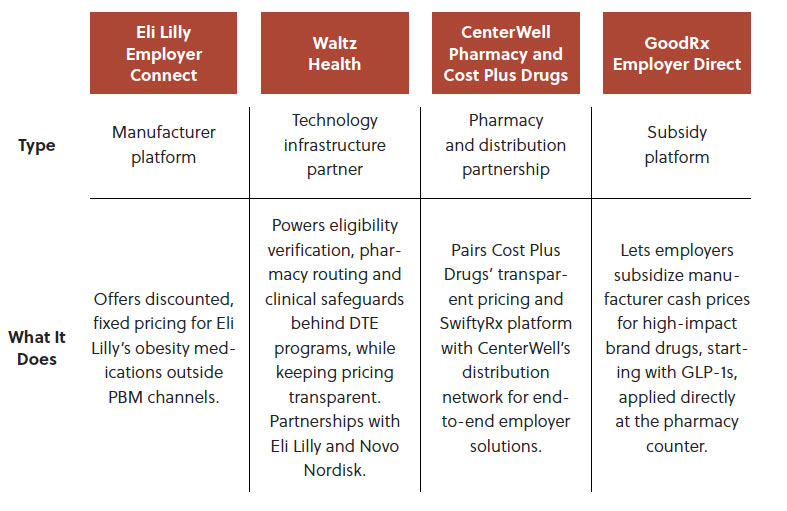
A growing number of drug manufacturers, technology platforms and pharmacy operators are launching direct-to-employer (DTE) prescription drug models that route medications entirely around the traditional pharmacy benefit manager (PBM) channel. In turn, this gives employers decisions to make that require new assessment. While still evolving, these platforms signal a mean-ingful shift in how high-cost medications, particularly glucagon-like peptide-1 (GLP-1) drugs for obesity and cardiometabolic care, may be purchased and delivered in employer-sponsored health plans. This cheat sheet outlines the advantages and challenges of DTE platforms.
Examples of DTE Platforms
The Pros
- Pricing transparency—Fixed, upfront net pricing eliminates rebate guesswork.
- Budget predictability—Set pricing means employers can forecast pharmacy spend with
- Faster employee access—Fewer prior autho-rization and step-therapy delays.
- Flexible design—Employers set their own eligibility and cost-sharing rules.
- Targeted cost control—Addresses high-cost drug classes (e.g., GLP-1s) without a full pharmacy overhaul.
The Cons
- Benefit fragmentation—Purchases may not count toward deductibles or out-of-pocket
- Data gaps—Bypassing PBMs means losing consolidated utilization and cost reporting.
- More administrative work—Employers take on added vendor oversight and compliance
- Limited scope—Most platforms cover only narrow drug categories today.
- Employee confusion—Multiple access paths can complicate how employees understand their coverage.
This Know Your Benefits article is to be used for informational purposes only and is not intended to replace the advice of an insurance professional. © 2026 Zywave, Inc. All rights reserved.
RECENT POSTS


NEWSLETTER
To receive more informative HR Articles and tips sign up for our newsletter